outside there is a war raging excuse me as i don my armour drawing battle lines in black framing my weapons so now shall all those mere mortals fall under this gaze
outside you can hear the words clashing crashing against each other i hope you don’t mind—i must also continue to whet mine beware if you see them drawn for i must parry back
outside i have too few allies wait one second? as i grab my stilettos you can never be too careful and i never can decide whether i feel like running or fighting till i am there best be prepared
outside there are many casualties injuries of every kind of the heart and of the mind of the body and the soul i regret that i cannot mend any of them but i must retreat and tend to my own i hope you understand
outside the wind rages on but inside there is warmth and a safety a serenity if you search hard enough if you can manage it i have never been able to but i hear that it’s quite nice
This is an older piece, probably written around 2014. I turned this piece in to the On the Rocks arts festival and a friend told me they had it hung in one of the churches in St Andrews, which is very cool…but I no longer remember why I didn’t/couldn’t go see it in person myself. Would’ve been cool to have a photo of that here, but alas…
Shoutout to Ms. Kenny’s senior year Shakespeare class! I guess it’s fitting to post this a decade after I originally wrote it…(yikes @me) I remember that I spent wayyy too much time looking up all the fun Middle English words to cram into this. I believe this was our final project; I chose to write, then memorise and perform an original “lost” monologue from Hamlet. I ofc have very strong opinions about Ophelia’s characterisation and wrote it accordingly. Author’s note at the end was included as part of my project submission. Enjoy…?
Ophelia’s Lost Monologue:
OPHELIA: [singing, sitting on a tree branch suspended above the pond while plucking flower petals and tossing them into the water]
(slightly deranged:) Drink to me only with thine eyes And I will pledge with mine Or leave a kiss within the cup And I’ll not ask for wine
[singing breaks off abruptly, as she snaps out of her “madness” and back into reality upon realising that she is alone and needs no longer pretend]
O Hamlet, how I wish to tell thee- I ken wherefore thy conscience didst decay. My father—gone! And all remaining kin have fast forsaken me, favouring instead their cozening and twattling, heeding not my laments of betrayal and my veiléd warnings of abounding treachery. How didst thou charge these ill-bred dissemblers, lest you carelessly apprise their suspicions? In the same manner I dost now, my lord, with my shadowed words and hidden meanings like a modest virgin fluttering her lashes at her suitors? Would that the drapes of their own self-absorption could strangle them in the same form it smothers all the innocents entangled in their webs of artifice! Erelong methinks their guiles and contumely shall benight me. Wherefore can they not see how the blades of such actions cleft their mores all atwain? Wherefore do they not perceive my words, though dressed as madness, cloak uncoinéd conjurations? Oh, fie; hath Claudius made another Janus pawn of dear Laertes? Guilty Gertrude succours me not, and thou, dear Hamlet, banishéd far to England be! Already can I sense my vaded sanity succumbing to my masqueraded madness; the lies become the truth, the truth deboshed by nobles cautelous in all. Alack! I fear nothing more remains for me here; in the Fields of Asphodel, perhaps I yet may seek solace. Foolish but fond Father I may find—or even that long-lost lady of leisure, now a mere echo in the shadowy corridors of my mangled memory—even she may yet I find comfort in! Only those who have traversed across the bourn of life still care for lost Ophelia. Forsooth, I cannot pretend the weeds of feignéd madness do not weigh upon my mind. I fear what more of me shall crumble beyond repair, what twisted shadow of myself would prevail. Nay; ‘twere better be remembered no worse than be I now. Misplaced regret here now I leave behind sinking dust along with yon debris to be from hence swept out by endless sea. Into the Lethe I unbounded flee to rest forevermore, enveloped by the infinite repose, that dreamless sleep.
[Ophelia gazes into the water, looking at her reflection. Silent tears trickle down her face. She turns away and looks up at the sky. With her back to the water, she rises on the branch and tips herself backwards, eyes firmly fixed upon the sky as she falls.]
[Beat]
[Muffled, hazy sound of splash]
FIN
Author’s Note: The song that Ophelia sings at the soliloquy’s start is called “Drink to Me Only with Thine Eyes,” based off a poem called “Song. To Celia,” written by Ben Johnson. The words of the poem were put to tune somewhere between the late 1700’s and early 1800’s.
Written and uploaded to Hey SoCal on 5 March 2024. The paragraph in red was omitted from the published version because it did not focus on the main organization, Union Station, and also deviated oh-so-gently into political commentary (I couldn’t help myself). The below also omits all the SEO phrase peppering I usually add to the newspaper version, too.
If you haven’t read any of my food articles, I—in a very unbiased manner—highly suggest you give them a read! I wish I had more time to do them 🙂
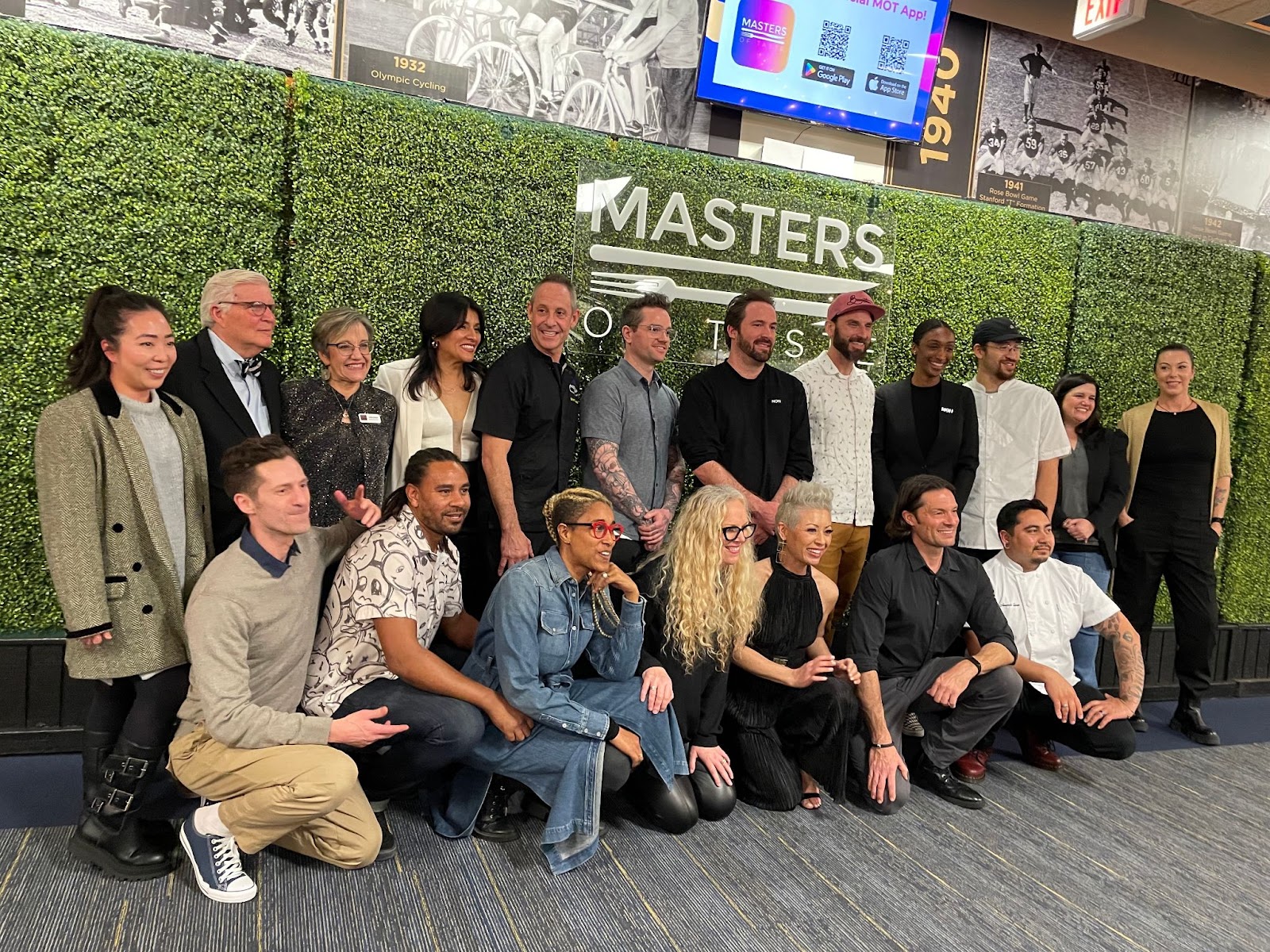
As Masters of Taste gears up for its seventh year, the event already boasts an impressive benchmark of funds raised thus far: 3 million dollars raised for Union Station Homeless Services (USHS). Year after year, the consistently sold-out event manages to bring hundreds of Los Angeles’s best restaurants together at the Rose Bowl to host an incredible food event…which just happens to be a fundraiser for a great organization helping to alleviate homelessness and provide housing to those who need it most.
The restaurants and vendors attending the event are just as passionate and enthusiastic for the cause as the Union Station team are. The press preview this year was a night to challenge commonly held misconceptions and often-repeated fallacies and phrases regarding homelessness.
Benjamin Turkle of Boomtown Brewery adroitly countered the oft-parroted phrase “pick yourself up by your bootstraps”: “We’ve always been told that we need to pick ourselves up by our bootstraps,” he began. “But that’s very challenging when we don’t have bootstraps to pick ourselves up by. It takes a community…to lend threads to others so they can make their own bootstraps; to lend hands so others can pick themselves up as well. We’re all in it together: and our rising tide will raise all ships.”
Shawn Morrissey, USHS’s Vice President of Advocacy and Community Engagement, has seen programs for homelessness change for the better over the nearly 21 years he’s been associated with USHS. “We used to make homeless individuals jump through hoops and blame them for the situation they’re in, make them earn their way into housing or their way out of the streets.” He shared his own story of addiction and trauma, noting that we are now better-informed and have better practices, including housing first models for alleviating homelessness, trauma reduction, and post-trauma care.
Morrissey clearly articulated: “[P]eople are not broken; systems are. One of the things we hear a lot is that drug addiction drives people to homelessness, but what we really know is that it’s a symptom of larger systemic and structural issues. In the 16 years that I’ve worked on the streets with people, I have yet to meet someone who chose not being sober over getting housing.”
Morrissey himself had been homeless, and came to Union Station for help. “And for the first time in my life,” he said, “I was met with unconditional regard and I was nurtured. I was brought into a community where people wanted an authentic relationship with me. These were the things that made a difference.”
Both Turkle and Morrissey’s words spoke to concepts of community care, that “we take care of us.” The solution, in an ever-expanding, globalized, overextended world is to move in the opposite direction: to look inwards, to turn towards our local communities, to collaborate and uplift our neighbors. Just in Pasadena, organizations like Union Station, Friends in Deed—who run a much-needed bad weather shelter—and Door of Hope, among others, are ones who provide support, care, and compassion to anyone who needs it.
So, what are your plans for the first weekend of April? Because if you love food, and you want to have a great time while contributing meaningfully to a good cause, I’d recommend you plan to attend Masters of Taste: https://mastersoftastela.com/tickets/
Photo by Brianna Chu / Hey SoCal
Preview night never fails to whet the taste buds for the actual event. Masters of Taste 2024 hosts, Chef Bret Thompson and Lucy Thompson-Ramirez, represented in full force, with dishes from both their Pez Cantina and their new concept, Pez Coastal Kitchen.
Photo by Brianna Chu / Hey SoCal
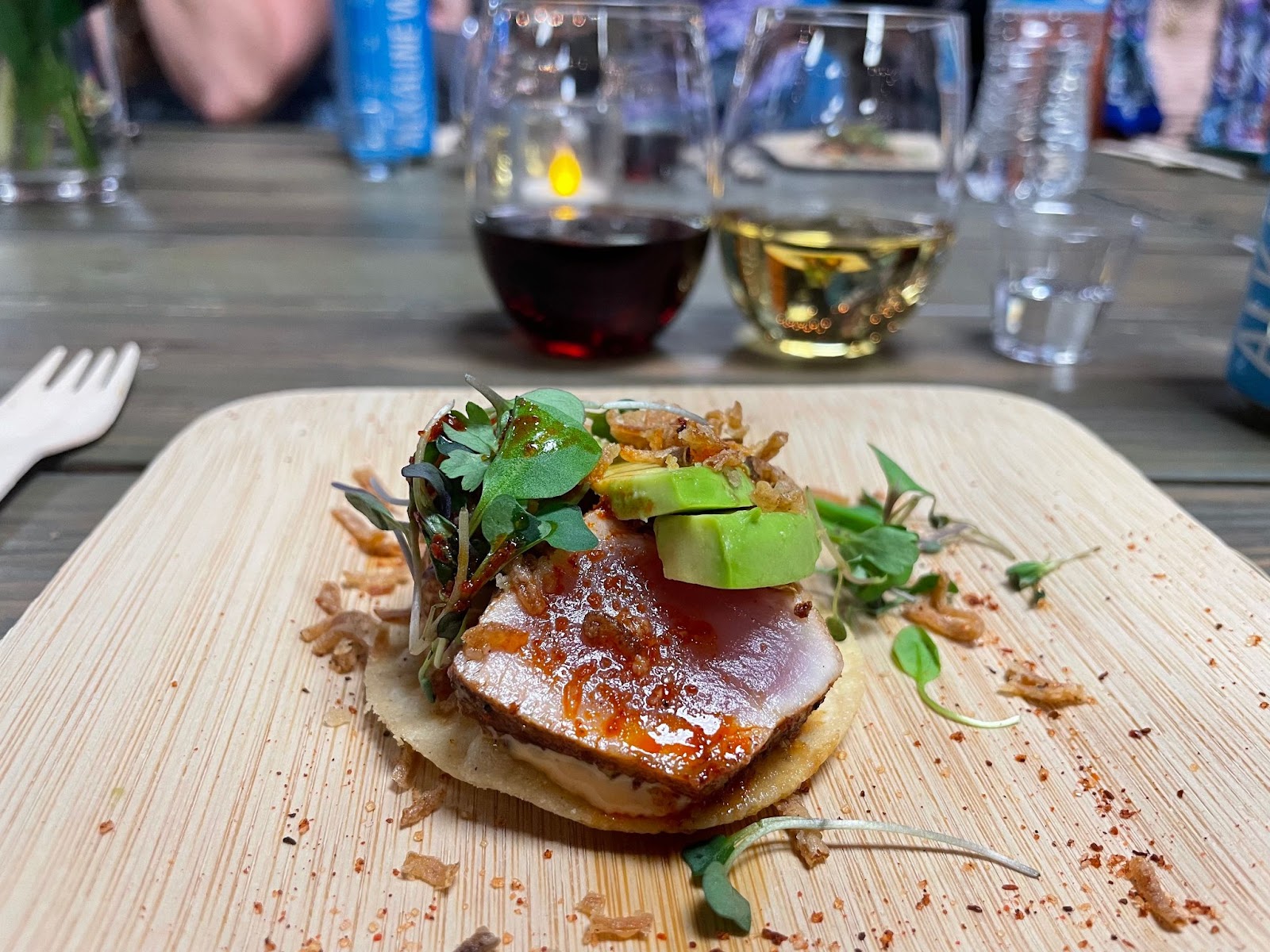
The evening started off with a bright albacore tuna tostada. The albacore was seared on the outside and coated with “Pez Powder”, the restaurant’s own version of the popular Tajín seasoning, for a delightful pop of added flavor. Chipotle aioli and avocado provided some smokiness and creaminess, while fried onion strings provided a more delicate crunch than the tostada. Mezcal 33 provided the alcoholic pairing to the dish, their strong and earthy Joven mezcal.
Photo by Brianna Chu / Hey SoCal
Chef Joel Hammond from Uchi West Hollywood served a hotate no tataki—a barely cooked, sweet scallop served in the shell, nestled in a pool of vermouth butter and topped with finger lime, thai basil, strawberry XO, and garnished with a few dainty drops of chili oil. Each mouthful was complex and nuanced: pop of the finger lime at the front of the bite; the thick, savory XO sauce made a touch sweet with strawberry; the rich vermouth butter bringing out the sweetness of the scallop meat. Each component built beautifully atop the last, collaborating as flavors while maintaining their own distinct, discrete identities. Crū Winery returned this year, pairing their crisp, bright, and fruity SLH Chardonnay with the scallop.
Photo by Brianna Chu / Hey SoCal
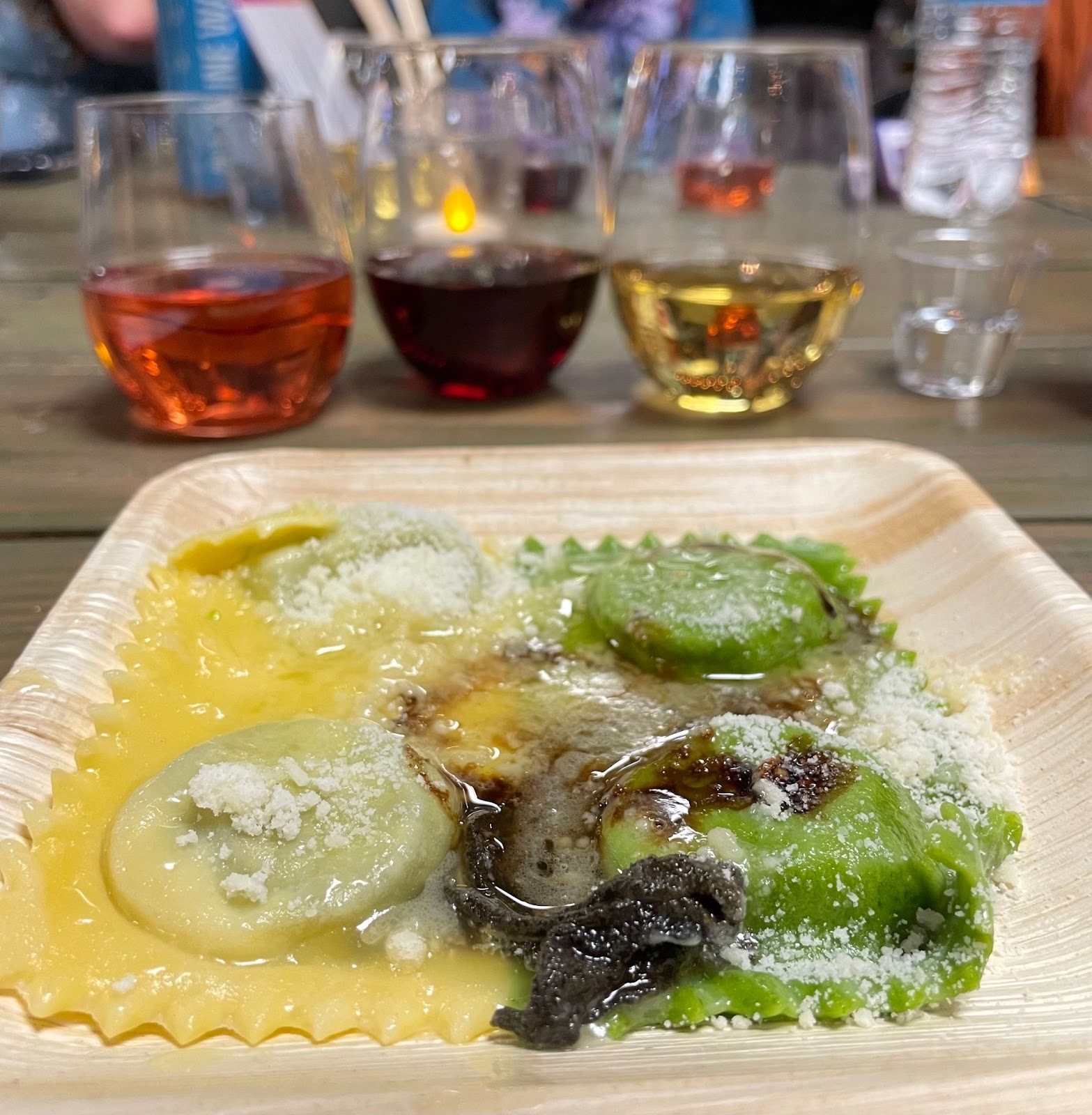
A decadent sfoglia di ravioli was Chef Luca Maita’s contribution to the meal. Lavo Ristorante’s executive chef did not disappoint: a classic spinach and ricotta ravioli elevated by a filling with ricotta de pecorino, a coating of luxurious and nutty browned butter, high-quality aged balsamic that was more sweet and rich than it was sour, fried sage, and Parmesan cheese. Full of deep, earthy flavors, the ravioli were easy to eat despite their richness: a cozy, comforting course that complemented a lighter, seafood-focused menu. Crū Winery’s SLH Pinot Noir was a rich, fruity companion to the dish.
Photo by Brianna Chu / Hey SoCal
Showcasing their recently opened Pez Coastal Kitchen’s American seafood house concept, hosts Chef Bret and Lucy served a crispy Pacific sea bass and seafood bolognese on a bed of Meyer lemon risotto for the final savory course. The char and chew of the skin was still a good contrast to the juicy, succulent sea bass meat. The Meyer lemon made the risotto easy, not heavy, to eat, paired with the light, almost fruity, “bolognese,” which was seemingly made of a white fish mixture. With some fried basil on top, I could see why even only a couple of weeks into their opening, this dish has fast become a customer favorite at Pez Coastal Kitchen.
Photo by Brianna Chu / Hey SoCal
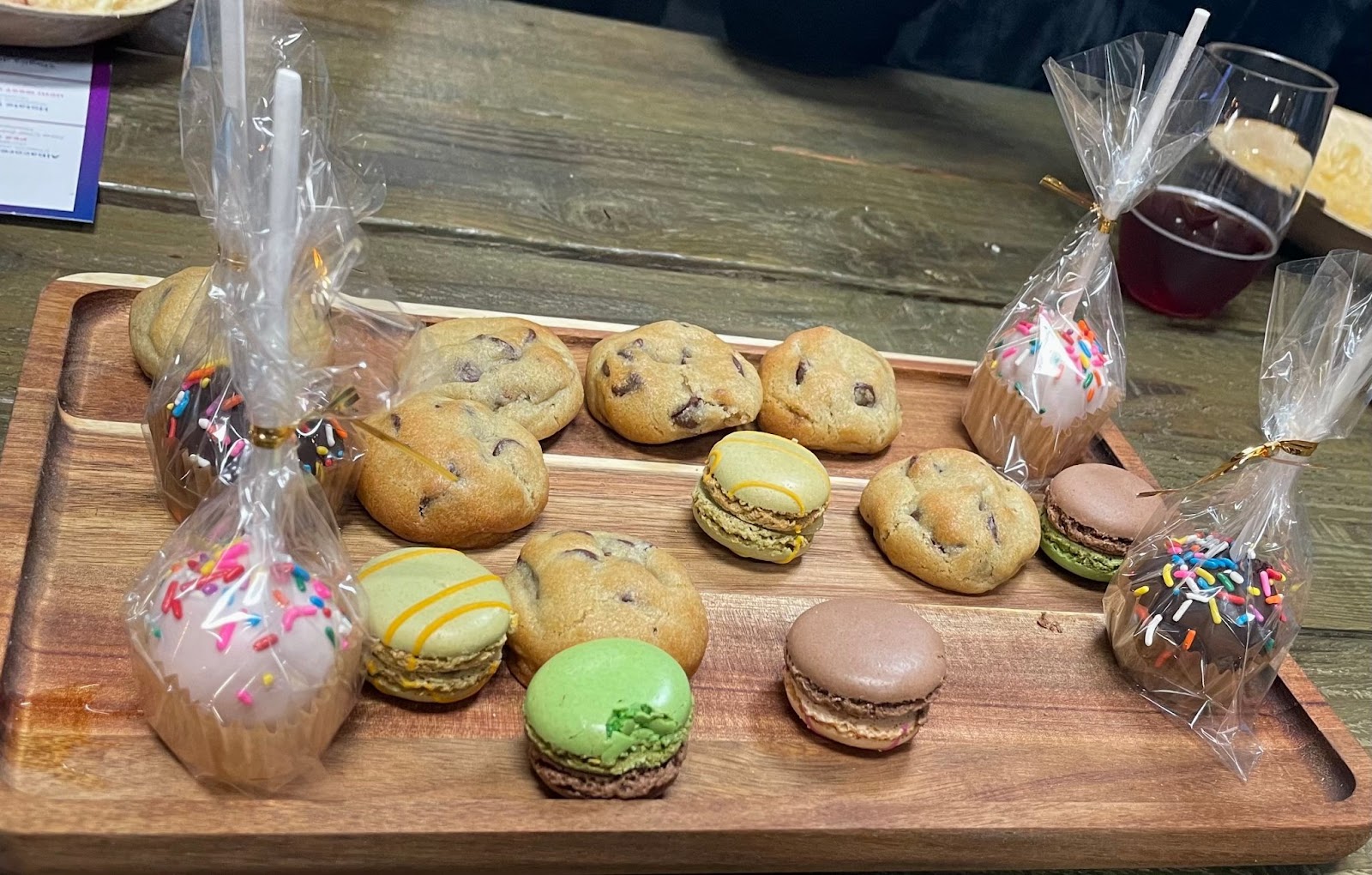
Alcohol-free beverage company NON provided a stewed cherry and coffee non-wine to accompany the final course. NON7, as the drink is called, featured strong flavors of garam masala with notes of date. They create their non-alcoholic drinks to have the same main four components that alcoholic beverages do: fruit, tannin, acidity, and salinity. To finish off the meal, Atti Rezaee of Joy & Sweets served up trays of assorted sweets: macarons and cake pops of different flavors, and thick, chewy chocolate chip cookies. I have to agree with her belief that “one of the visceral ways to feel love is through the stomach”—and what a night of love and joy from this culinary crowd.
Please don’t wait to buy your tickets to the year’s (in my opinion) best food event: https://mastersoftastela.com/tickets/! Masters of Taste consistently sells out, and even had to add 60 more tickets to last year’s event due to high demand. VIP tickets allow you to enter at 3 pm, while General Admission begins at 4 pm. This year, there is also a Masters of Taste app that will allow you to see a map of all the vendors on your phone so you can make your way deftly amongst all the hundreds of incredible stations, and you can also add favorites so you know exactly where you want to return to!
Left to languish in drafts; originally started in June of 2022, finished July of 2023…almost managed to get it up by June…
For many people of the global majority, existing in certain—especially Western/Global North—spaces constitutes resistance. Resistance against the status quo, of making space for yourself at the table, of refusing to be ignored or pushed aside.
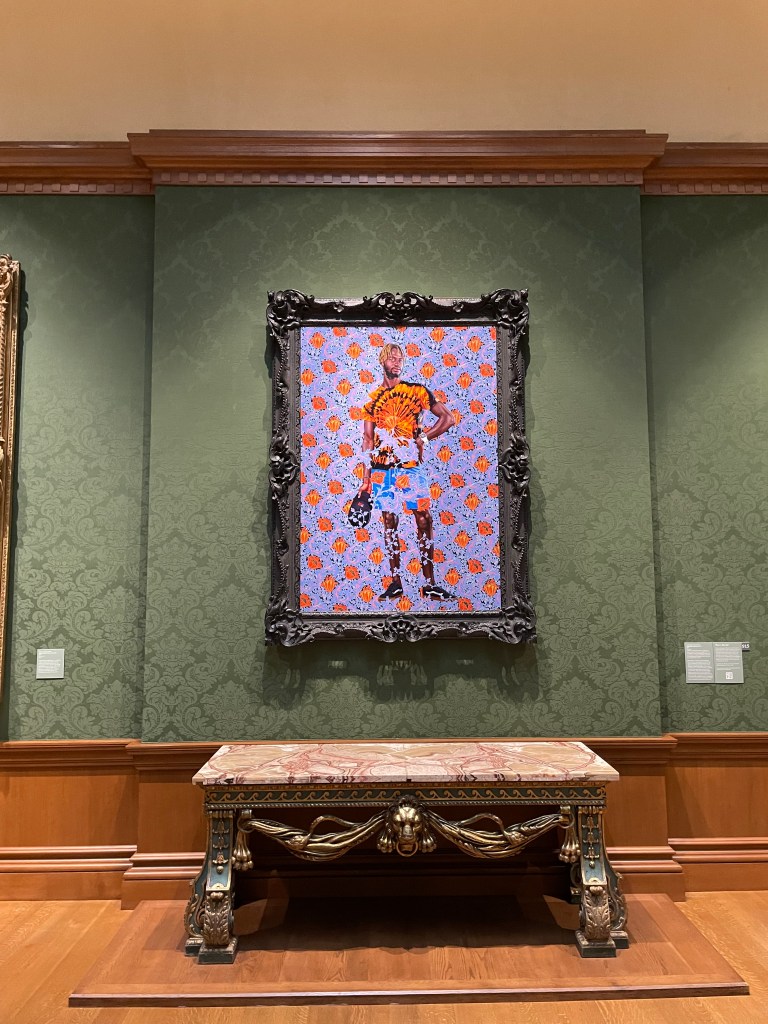
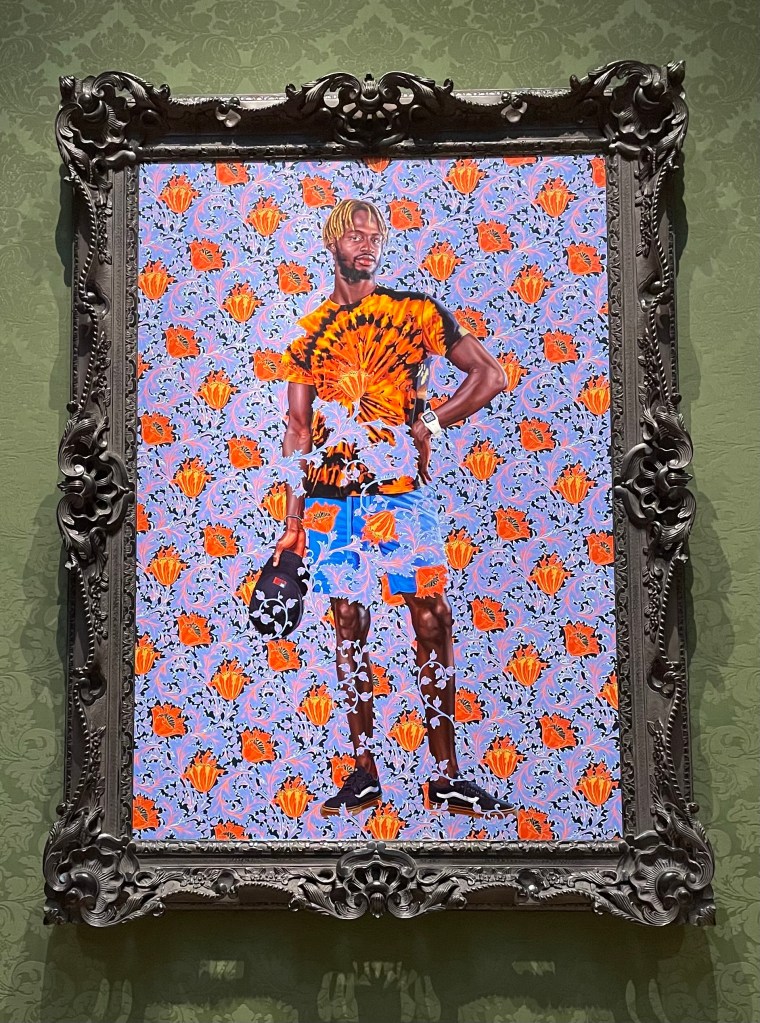
Kehinde Wiley’s “A Portrait of a Young Gentleman,” on display at the Huntington Library and Gardens, is one such act of resistance. I can’t speak to the intentionality or the self-awareness of the curators, though I sincerely hope that this was their intention. However, I personally find that “A Portrait of a Young Gentleman” completely transforms the experience of visiting that particular wing of the European Art Gallery.
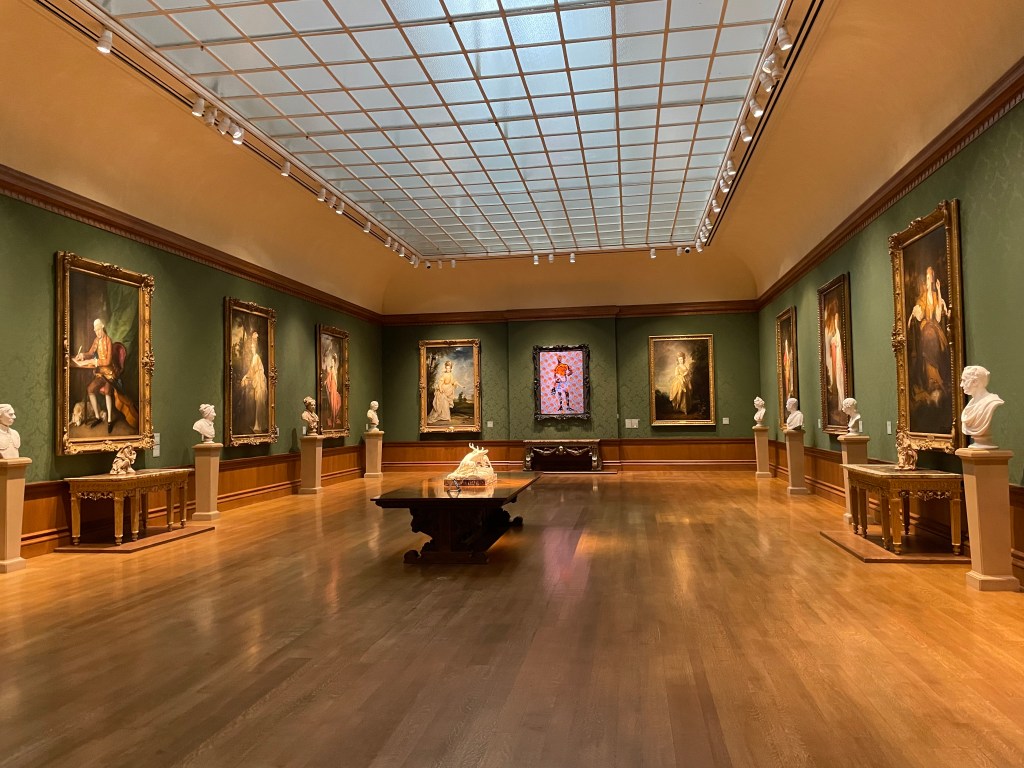
Recently, “Blue Boy”—the Thomas Gainsborough’s portrait is one of the museum’s most iconic pieces—was loaned to the National Gallery in London, while Joseph Wright’s “An Experiment on a Bird in an Air Pump” was loaned to the Huntington. During “Blue Boy”‘s absence, Wiley’s “Young Gentleman” was displayed in his usual place, a stunning contrast jumping off the wall as soon as you walked into the wing.
The wing in early February 2022.
As soon as you set eyes upon the gallery, the vivid lavender and the fiery orange of the California poppies in the background of the portrait stand out against the muted, warmer tones of the other portraits and even the gallery itself. The stark impact of the matte black frame is appreciable under the lights. The detailed rendering of the Young Gentleman makes his figure pop and contrast, three dimensional against the sea of two dimensionality. His pose mimics that of Gainsborough’s Blue Boy, his expression serene and calm—but his very existence, a loud and proud presence in a sea of portraits of…to put it bluntly, colonizers, is a stunning and impactful statement. He commands attention and importance in a room dominated by whiteness and elitism, in a place of pride. His mere existence pushes back against the status quo that the gallery embodies.
With Blue Boy’s return, the young Gentleman remains in the gallery but has been placed opposite, continuing to resist the status quo with his continued presence. (I hope this remains the case as of this publishing!)
Below is a longer, less edited version of my article for Hey SoCal, published April 25, 2023.
Does the term “Asian American” do more to include or exclude the many cultures that fall under it?
How valuable is the increased Asian American inclusion in media to everyday Asians—is that representation meaningful enough?
What does it mean to be American? Who has the right to wear that title and to share fully in the promise it implies?
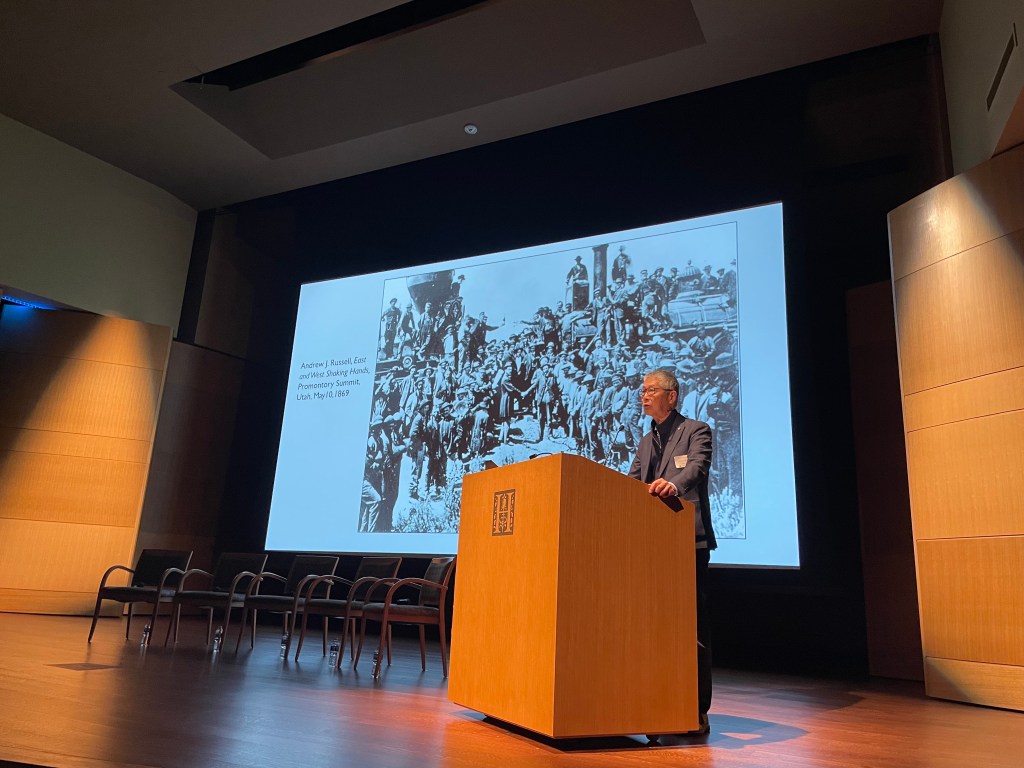
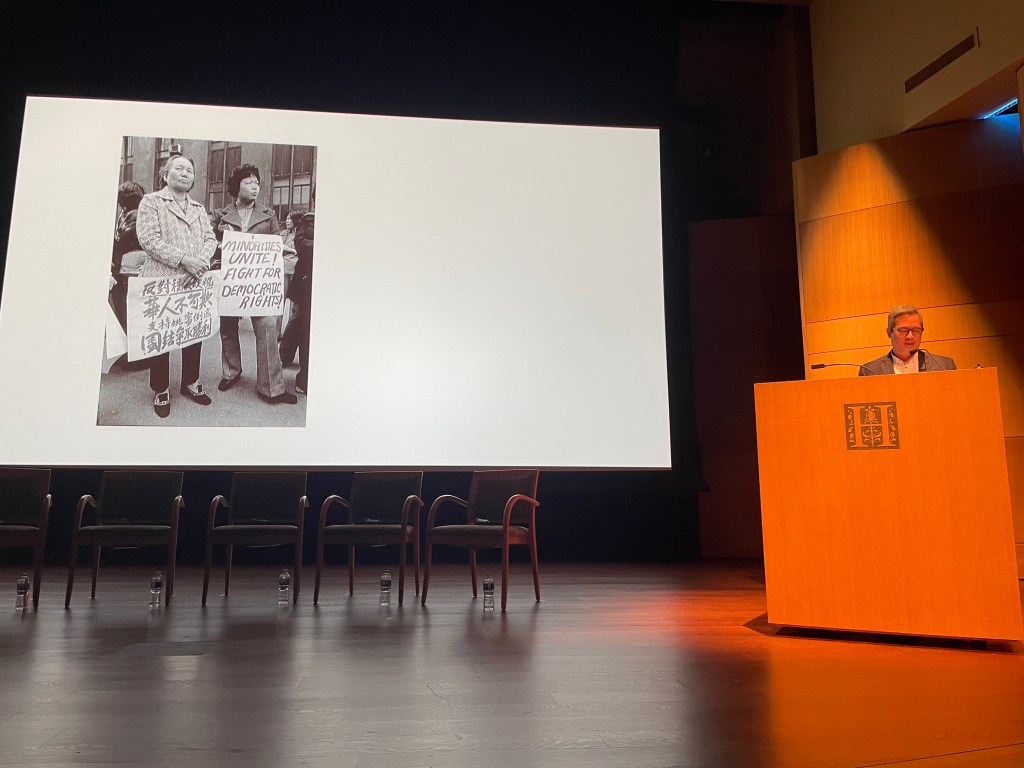
These are the questions that Simon Li prefaced the Huntington’s Asian American Experiences in California symposium with on March 4, 2023. I was only able to attend the first and last panels, missing out on the “present,” so the anecdotes I highlight below are only from those panels. However, you can watch all three panels on the Huntington’s website here.
“East and West Shaking Hands” | Photo by Brianna Chu
During the “past” panel, each speaker reoriented—every pun intended—the current framing of Asian American history. In examining the history of Chinese-Americans and their role in building the railroads across America, Professor Gordon Chang featured a photo entitled “East and West Shaking Hands.” At first glance, it’s nearly impossible to see any Chinese individuals in the photo at all; the lone Chinese worker, in tattered worker’s garb, was captured with his back facing the camera. Most importantly, he was captured mid-movement, blurry and literally out of focus: the perfect metaphor for the lack of focus on the role of Chinese workers in this grueling feat of transportation they were instrumental in completing. Writer Jean Chen Ho examined the flawed, skewed history of the 1871 LA Chinatown massacre. The most prominently known story of the event submits that a duel between two Chinese men from rival tongs caught a white rancher in their crossfire. This death spurred a predominantly white “vigilance”—or should we say, vigilante—party to consequently murder dozens of mostly uninvolved Chinese people in the process of purportedly attempting to save them, additionally destroying and robbing Chinese businesses in the process. Writer Naomi Hirahara walked us through the Japanese businesses and community members of Pasadena pre-World War Two, and asked us to imagine with her what the town would have looked like had Japanese internment not happened—if the Japanese businesses and communities built there had the chance to continue. And amongst the many pieces Art History Assistant Professor Marci Kwon presented, a personal standout was a piece inspired by the “I am an American” sign that a Japanese grocery in Oakland erected on their storefront following the attack on Pearl Harbor, hoping to forestall the violence to Japanese-Americans that was to come. Contemporary Filipina artist Stephanie Syjuco took that historical image and reframed the statement as a fabric banner, in which she compacts the letters comprising “American,” asking viewers to contemplate what being an “American” means to them.
Stephanie Syjuco’s installation
Each speaker highlighted an incomplete, overlooked, or undervalued narrative of Asian life in America—delving into the history we have, the Eurocentric perspective from which it was written, and how we might fill in the gaps of our own history. In answer to my question about why we should look to the past and what value we can take from re-evaluating it, Professor Chang eloquently stated that this work helps to reframe American history, properly acknowledging our centrality in the story of the creation of what is currently referred to as “America.”
Jimenez Lai’s whisper-distorting installation. | Photo by Brianna Chu
In the “Future” panel, each speaker presented a provocation to the audience regarding how we might envision the future of Asians in America. Stop AAPI Hate co-founder Manjusha Kulkarni made the provocation that our fear and anger as a collective group of many different Asians in America drives us towards increased civic engagement, and hopefully in turn, improving outcomes, legislation, and representations of Asians in politics. Lawyer Karin Wang asked us to acknowledge the privileges the Asian American community has and consider how we might use that power to uplift others, especially other communities of color. Artist Jimenez Lai shared and described an installation he had created, in which visitors could whisper their fears, and hear them return as a distorted version of that sound. This piece stood out to me as a reminder to acknowledge our fears for the dissonance and distortions of the truth that they are, and to take the space to reimagine our world in ways that don’t currently exist. Writer Jeff Chang brought us home by prompting us to consider the future Asian American community we envision—one that is only brought together by collective experienced oppression? Or one brought together by shared values? And to create a collective community of joy and care, what values are we rallying around? How do we build this community of the future, one that endures?
Jeff Chang muses on our future communities. | Photo by Brianna Chu
For my part, the answer to Li’s first two questions is clear. Yes, the term Asian American continues to hold merit. Li acknowledged in his own remarks that others outside our Asian community will not bother to harbor distinctions between Chinese-Americans or Japanese-Americans, as in the case of Vincent Chin. Instead, we have, are, and will likely continue to be ‘categorized’ by our overarching heritage: Asian. Thus, we do share common experiences here in America even as we uphold and celebrate our many distinct cultural traditions. However, we can incorporate both the collectivism of our heritages and the individualism touted by America: as Asians in America, we can uplift and still celebrate our individual, unique heritages, under a broader, joyful community of Asian American. More diverse and widespread Asian American representation, in every space and circumstance, matters. Hearing from voices and experiences from across the wide diversity of Asians in America matters tremendously: we cannot know the experiences of others, nor help them, if they are not present for us to listen to.
The “Future” panelists. | Photo by Brianna Chu
On that note, a personal opinion and observation I might levy upon the symposium was that the speakers seemed pleased with the diversity of the concluding panel, but overall, I noticed that East Asian speakers dominated the symposium. It is increasingly acknowledged that East Asian voices are often most prominent in discussions around Asian-ness, for lack of a better term. South and Southeast Asian voices are less often heard—and indeed, in this symposium, the only South Asian representative was Kulkarni, and the main Southeast Asian speaker was Linda Trinh Vo during the “Present” panel. Filipinos are also a notable Asian majority in California—for instance, Filipinos are one of the first Asians, if not the first, to step foot in California, brought as slaves on Spanish galleons in 1587—and the symposium did not include any Filipino speakers. I understand that every event has its limitations, but I offer this as food for thought for any future symposiums, which I sincerely hope the Huntington will consider organizing.
I’ve vacillated tremendously between feeling “American” and not. Most of my life, this identity has been dictated by those around me, not myself. Even growing up in Pasadena, I’ve often felt that I didn’t fully fit whatever the perception of dominant American culture was at the time. My parents are immigrants from two different countries, bringing their own traditions here, choosing what to keep and remixing “American” traditions with whatever felt right to them. We often didn’t know what the norm for everyone else was; I would speak with classmates about how I spent holidays or what traditions my family followed to mild surprise or quizzical looks. I’ve seen firsthand what stereotypes people have imposed on my parents—the mildest of which is assuming they don’t speak English. Up until the age of maybe 18, if you had asked me, I probably wouldn’t have identified as American. And when I left the US to study in Scotland, the label “American” was applied to me by others, due to the accent and prevalence of Americans attending university at St Andrews.
It’s only since I’ve returned that I’ve felt that I could define and choose what being “American” really means to me.
And I think I’ve come to a similar conclusion as many others in my generation: that no one can truly define whether another person is “American” or not, since, excepting Indigenous folks, all of us are immigrants to this country in one generation or another. What is “American,” except the multifaceted evolution of many cultures meeting?
However, while representation does matter, the type of representation, as well as the action to accompany it, matters more. While the definition of American depends on each individual, to choose to identify with that identity and create meaning for oneself, it seems that there is agreement regarding the responsibility that comes with that identity. During her presentation, Kulkarni quoted iconic Chinese-American author and activist Grace Lee Boggs: “I’ve come to believe that you cannot change any society unless you take responsibility for it, unless you see yourself as belonging to it and responsible for changing it” (2009). And my mother, with whom I attended the symposium, echoed the same thought in her own reflections:
“But being American comes with responsibility. We have to give back to the country we now call home by engaging with our community and actively seeking out how we can contribute to society. In areas where we have influence, we have to advocate for all people of color and use our voices to speak for those who can’t. At the very least, sharing our stories might help others understand that while we don’t look like them, we have similar hopes and dreams, and are striving for the same happy outcomes.”
And I wholeheartedly agree with those sentiments. Our world was not created in a vacuum: countless individual decisions and actions, over thousands of years by civilizations and societies both recorded and forgotten, have accumulated to fashion our current society. We, as a collective humanity, have shaped the world as we know it today. Thus, my personal answer to Chang’s question, of how to build a community that endures, is simple: by living and acting upon the change we envision. For me, that means listening and making space for others to tell their stories, and sharing my own experiences and stories with others—continuing to contribute unique patches to the overarching quilt of stories of our Asian American community. There has been, and continues to be, discord and othering in and amongst our own diverse Asian communities, which frankly is a common occurrence in any group of people. But especially in the past few years, I have reflected that the “both…and” mentality is the one I want to take in life: Acknowledging that more than one perspective is valid and true and meaningful. Making room for the experiences of others. Respecting the experiences of others. Asking others to do the same for us and our own lived experiences. And ultimately, working to create communities of respect, care, inclusion, and hope.
I highly encourage anyone interested to watch the videos of each set of panels—many thanks to the team at the Huntington for assembling this symposium.
The pandemic has exacerbated many of the struggles of our unhoused neighbors; the search for shelter and employment has become ever harder.
Single mom Rosemary* worked two jobs pre-pandemic, renting a room for herself and her toddler in a house with seven others. Each of the tenants worked different jobs and hours, so despite the numbers, the living arrangement worked, since they weren’t all at the house at once. However, once the pandemic hit, the house quickly became a difficult place to cohabitate. One person played music loudly during the day, disrupting those working, and she couldn’t retreat to the outdoor space to work—the Internet connection didn’t reach that far.
Rosemary managed to move back home to her parents’ house over the summer, where she was able to save money despite working only one of her jobs, since it wasn’t physically possible for her to take care of her young child with both of her previous jobs. While living with her parents helped save on rent and food costs, the experience was strained and uncomfortable; her parents looked down on Rosemary for being a single mom and often made her feel like a burden. “I remember them asking me, ‘Why can’t you pull yourself up by the bootstraps?’ …Well, I was able to handle it when I had more jobs and could take [my child] to daycare.”
Towards the end of the summer, she was able to contact a friend who could rent her a room and quickly prepared to move out; but the offer suddenly fell out when the friend’s landlord unexpectedly revealed they were planning to sell the apartment instead. Rosemary spent a month searching for a new place to live, eventually finding Door of Hope, a Christian organization that provides transitional housing and other resources, with the goal of ending the cycles of homelessness and domestic violence and abuse. Door of Hope also provides its tenants meals, and their normal housing period of three to five months has been extended to nine months in response to the pandemic.
Rosemary and her toddler have their own room, and everything else is shared. The two now live in a house full of other single moms, which Rosemary is finding to be a great experience, as she can learn how other single moms handle raising their kids. Despite the rollercoaster journey she persevered through in 2020, Rosemary reflects sagely about the entire experience: “My parents live in a big house and are well off, but they’re miserable…When you’re homeless, you understand what’s truly important; and I look at my [child] and know I have everything I need.”
Rosemary’s experience with housing insecurity is one amongst thousands of others just in Los Angeles County alone. The 2020 Greater Los Angeles Homeless Counts, initially published June 12, 2020, revealed a 12.9% increase in homelessness in Los Angeles County between January 2019 to January 2020. However, this number doesn’t take into account the countless who have since likely fallen into homelessness or housing insecurity as a result of income loss from the pandemic. According to the Los Angeles Controller’s Office, the unemployment rate in Los Angeles County was 15.1% in September 2020, though the peak unemployment rate, rising above 20%, was recorded in May 2020.
A May 2020 paper from UCLA’s Luskin Institute on Inequality and Democracy suggested that an “optimistic assumption that only one tenth of households will experience homelessness leads to an estimate of 36,000 newly homeless households, including about 56,000 children”, though author, Professor Emeritus Gary Blasi, writes that “a reasonable estimate is that at least one third of those households at very high risk of being evicted (365,000) will become homeless, with no source of income.” Based on the ‘reasonable’ estimate, “we can expect to see the unhoused population of Los Angeles County grow with the addition of at least 120,000 evicted tenant households, including 184,000 children.”
The California-wide Project Roomkey, aimed at providing shelter for single adults experiencing homelessness who are at high risk for COVID-19, has been a collaborative, multi-organization effort. In Los Angeles County, Union Station Homeless Services (USHS) has partnered with the Los Angeles Homeless Services Authority (LAHSA), working on the frontlines to get folks off the street and into hotel rooms, especially those at highest risk for COVID-19. Project Roomkey has been able to offer every person three meals a day, accompanied by a temperature check and verbal check-in with a nurse. The University of Southern California’s Keck School of Medicine contributed to Project Roomkey by sending a team of doctors to provide medical care, and the Los Angeles County Department of Mental Health provided mental health specialists, especially to help with the isolation. LAHSA reported that “efforts to protect the most vulnerable people from COVID-19 led to the rapid sheltering of 6,010 people since the March Safer at Home order (4,056 through Project Roomkey, 1,708 in Rec and Parks shelters, and 246 in trailers)—and a goal to move 15,000 of the most vulnerable people experiencing homelessness into housing.”
Project Roomkey daily nurse check-in. | Photo courtesy of Los Angeles County
LA County is working with state, federal & local partners on Project Roomkey–an initiative to bring medically vuln… twitter.com/i/web/status/1…— Los Angeles County (@CountyofLA) April 06, 2020
Project Roomkey is a temporary program, however, meant to alleviate the worst of the pandemic for as many homeless folks as possible; and now they are starting to transition Project Roomkey to Project Homekey, or Recovery Rehousing. USHS offers a rapid rehousing program similar to Project Homekey, for which their Interim Director of Project Roomkey, Lorena Ruiz, worked pre-COVID 19.
Union Station has been working not only to temporarily house as many people as possible through Project Roomkey but also to find them permanent housing. Ruiz was able to share some stories of a couple of gentlemen whom Union Station had recently been able to rehouse. On one of the first few days of the program’s implementation, a composed, dignified gentleman, who appeared at first to be in his 60’s, approached a Project Roomkey coordinator onsite. This gentleman, Oscar, surprised the coordinator greatly by revealing himself to be 90 as he was being registered. He was swiftly moved into a hotel room and matched with a care coordinator; and recently, he even moved into his own unit.
Another anonymous gentleman in his early 40’s had recently become homeless right before the pandemic, finding himself sleeping on a bus bench, unable to find work. He had no phone number, no address, no way to even get to interviews. Shortly after the pandemic began, he was approached by an outreach worker for Project Roomkey and moved to a site. He was eventually connected with a care coordinator for Recovery Rehousing. When he spoke with his coordinator, he told them: “All I need is an address to give to employers so I can get a job and a safe place to sleep.” Having a stable source of food and shelter allowed him to focus on employment, and he was already so proactive in searching for employment that his care coordinator didn’t need to spend as much focus there. Early in December, he had found a unit that was affordable for him and signed his lease, and was able to spend the holidays in his own place.
While these three individuals have been able to find housing, there are still thousands who have not, and there is a lack of resources, support, and programs in place to address this crisis. However, we can all help to end homelessness: by volunteering, donating, and educating ourselves and others.
The LA Times collated a guide of volunteer opportunities over the holidays; and while the festivities are over now, these organizations could likely still use your time and aid. Right now, you could also volunteer your time by calling some folks and easing the isolation of lockdown by having a conversation with someone, and there are plenty of organizations in need of drivers willing to drop off groceries and essential items.
If you are a homeowner with a spare room or back house/‘granny flat’ that you are willing to rent out, Union Station always wants to partner with property owners. This direct partnership helps to protect both the landlord and the tenant.
Of course, donations are always very welcome: whether it’s a recurring online donation, gift cards to stores like Smart and Final to help with food purchases, or in-kind donations of essential hygiene products, household items, and food.
A final valuable step we can take is to educate ourselves and others on homelessness and become advocates for societal change. Union Station has an educational series and action guide called “Changing the Narrative”. There are currently two Changing the Narrative webinars, which you can watch here and here. The series and guide explain how and why housing first works, and explore what barriers there are and why they exist.
We have seen the pandemic exacerbate and highlight many of the pre-existing problems, from the ever-increasing wealth gap between the lowest-income and highest-income populations, to the strain on and limits of our healthcare systems, to racism towards BIPOC. Taking the time to educate ourselves and work to reject the norm of homelessness fits into the theme of the pandemic for many—a hard, long look at our society and what we believe in and value.
*Name changed for privacy
Afterword: This was the first article of the series that I worked on, and I felt the urgency and importance of the topic the most serious, so it is the only article of the four that includes a call to action at the end.
Originally published January 14, 2021 for Beacon Media News. Since then, the Washington Post (March 13, 2021) and Teen Vogue (August 28, 2021) have written articles on the same topic, conducting similarly focused interviews, though the latter focuses on how schools will handle mental health going into the 2021-2022 school year.
By Brianna Chu
When school districts were forced to close as COVID-19 arrived in the U.S. last March, students were thrust into an entirely new world of learning. I spoke with four students from elementary school to high school—Altadena Arts Magnet School students Kaidyn Taylor, a fourth grader, and Harry Daniels, a fifth grader; Chandler School seventh grader Vaughn Cross; and Gabrielino High School junior Emily Casciani—to get a snapshot of what school has looked like for them this past year.
While the students learn at different paces and various levels of difficulty as the grades increase, crossovers in experience abound. All four of the interviewed students cited the inability to easily communicate with teachers as one of the main challenges of learning from home. There is more limited dialogue between students and their teachers, since the primary time they spend with their teacher is with the entire class. While teachers do sometimes have designated online office hours, commonly on Wednesdays, there are impediments that come with the solely virtual connection. Kaidyn, for instance, had dealt with the difficulties of not being able to “figure something out but my teacher’s working with somebody else” during the normal in-person school term; however, the biggest problem for her is that “usually, I ask one of my friends for help,” she explains, “but [now] I can’t do that, either.”
Another significant challenge, especially for Vaughn and Emily, who have higher online workloads, has been maintaining focus and “attention while looking at a screen; it’s much harder than being engaged in a classroom where you can see things happening, watch your teacher, experience the experiments firsthand,” in the words of Vaughn. He uses science as an example: while the experiments have been modified to be reproducible at home, he feels that the experience isn’t quite the same as it would be in school with his class and teacher there.
Archana Basu, clinical psychologist and instructor in the Division of Child and Adolescent Psychiatry at Massachusetts General Hospital and Harvard Medical School, describes: “Children generally learn well when actively engaged and in environments where they feel safe and socially connected. While there’s a lot that one can do online—I think there’s been a huge surge in innovation and adaptation—remote learning requires a level of sustained attention and emotional regulation that is a very big demand, developmentally, for kids in middle school and younger.”
Maintaining or creating those social connections has been the most striking challenge for all the students. Whether “it’s talking to friends or having time to talk to a teacher, you can’t just go outside and say, ‘hey, do you want to do this later;’ you have to type on the computer and it takes a long time to respond,” notes Harry.
Getting used to online learning has been complicated for Vaughn, since he switched schools over the summer. He finished his second semester of sixth grade learning at home as a Saint Mark’s School student, and the pandemic certainly factored into his decision of which middle school to attend going forward. Consequently, one of the main factors prompting his choice of middle school was whether he already had friends there. As a new Chandler student, socializing with his classmates hasn’t really happened at all for Vaughn, either. While he’s been able to get to know more of his class individually while completing group projects together, Vaughn comments: “You can only get to know people so much when working on projects. I can say I know them, but do I really know them as friends? On a personal level?”
Even during the school day, recess, lunch, and during after-school arts or sports activities also constitute valuable time for students to spend with their peers, but none of the students I talked to can currently participate in most of their previously-attended extracurriculars: Kaidyn and Harry have been unable to play any of their sports; Vaughn can’t join Chandler’s band or orchestra; and Emily hasn’t been able to continue cheer or speech and debate, though she is still working on her Girl Scouts Gold Award and has joined the Associated Student Body at Gabrielino to be more involved with her school community.
Lack of socialization with friends and loved ones has significantly impacted children across the country. A report published by the Center of Disease Control on November 13, 2020 compared the number of mental health-related emergency room or emergency department (ED) visits among all pediatric visits in 2020 to 2019. EDs are “often the first point of care for children’s mental health emergencies,” and the report found that “beginning in April 2020, the proportion of children’s mental health-related ED visits among all pediatric ED visits increased and remained elevated through October. Compared with 2019, the proportion of mental health-related visits for children aged 5–11 and 12–17 years increased approximately 24% and 31%, respectively.”
And it is in this realm of interaction that video games are winning the pandemic. It’s not just kids that sent the sales of the Nintendo Switch and the newest Animal Crossing skyrocketing this summer—adults in spades went on to sell both the game and consoles out as the game became a method of interaction and online friendship. Online co-op video games of all kinds have become the clear winner for virtual connection for kids of all ages during the pandemic. Harry’s mom Aimee Daniels acknowledges that their rules on video games had been more strict pre-pandemic—“video games only on weekends”—but have become more lenient recently as it’s now the primary way for the kids to interact and even just catch up outside of the classroom, as Harry uses his in-game chat to speak with his friends. Kaidyn and her friends like to call each other and play Prodigy, an educational math game. Mom Jessica Thomas was happy to sign her daughter up for Messenger Kids so Kaidyn could interact more with her friends. “As adults, we [often] don’t think about just how difficult it is for the kids as well,” Thomas says. She definitely sees the difference interaction has, even with her youngest, who’s one. On the days he’s gone to daycare, she’s noticed he’s in a good mood and is ready to go to sleep at the end of the day; but after being home for two to three days in a row, he’s cranky all day. Emily calls and connects with her friends through FaceTime, and they sometimes play online games like the recently popular Among Us together. And in her case, through these games, her social circle actually grew as she met friends of friends whom she had heard of but hadn’t really spent much time with before.
While both kids and parents—and not to mention teachers, too—are inundated by the extra mental and emotional strain of learning and working from home, ultimately, safety is of the utmost concern for all parties. Emily remarks: “I would like to go back [to school] as soon as possible, but I’m afraid of health concerns that would ruin the experience I once had; if it’s harder to be in person for students and teachers, it may not be worth it.” She’s hoping publicity and usage of the vaccine increases, for everyone’s safety—and her concern isn’t misplaced. The Los Angeles Department of Public Health reported the highest spike in the average number of cases per week Los Angeles County School Districts in December 2020.
Graph from the Los Angeles Department of Public Health
COVID-19 has affected Emily’s college search, too. Unfortunately, she hasn’t been able to visit the schools on her list, but she has also been changing her list based on how she’s seen different states and schools handle the pandemic. She is undeterred in her desire to attend college, though; her parents have told her about how formative college was for them, and she wants to be able to experience that, too.
However, whenever she does return to school in-person, Emily feels that the biggest change will likely be “gratitude for being able to see people and have people helping me in person, [and happiness] for what I have in comparison to what I have now [in lockdown].” All of the students eagerly await the day it is safe to return to their classrooms and meet and be reunited with their classmates; but for now…maybe it’s okay to cut the kids a little slack for all that time spent playing video games.
Afterword: This wasn’t the original direction I had planned to take thisarticle; in the research I had been conducting prior to the interviews, I was focusing on the statistics relating to reported COVID-19 cases in Los Angeles County schools. However, as with all stories, the real direction comes from the people. After talking to all the students, I realised the real story here was mental health, and the tremendous toll the pandemic was inflicting on kids. And of course, then WaPo and Teen Vogue got onto the topic, too! Kinda cool how it feels like I beat them to the punch 🙂
Single mother Lisa* is a teacher who also tutored students before the pandemic started. Her young daughter Joanna* is not quite school age, so she isn’t currently juggling both online teaching and online learning; but Lisa had been sending her daughter to daycare during the week so she could work. After the pandemic hit, Lisa was unable to both teach and tutor. In their particular circumstance, they ended up having to stop going to their local daycare due to a combination of concerns over illness, financial strain for both their family and the daycare center, and some not quite above-board practices on the daycare’s part.
Lisa initially found spending more time with Joanna a joy. She had been volunteering with the preschool-aged kids at her church in preparation for her own little one getting older, and she loves children of all ages.”Trying to ensure [Joanna] is quiet or sleeping while I teach can be a challenge,” she says, “but sometimes I show my daughter the videos or material that I’m teaching.” However, while they love each other very much, Lisa notes that it’s still important to connect with others, too. The emotional pillars she had relied on—like the friends she could visit with and the church and single mom groups she could attend—have waned since the pandemic began. Lisa knew that as a single mom, she needed support; even pre-pandemic she had joined several single mom groups and mothers’ Bible studies at church.
Luckily, some of the single mom groups still meet online, and the pair have still been able to attend church; they can continue to attend because theirs implements social distancing and appropriate mask-wearing. Joanna loves going to church and being able to see other kids, too, so it’s important for them both.
Lisa is looking forward to being able to go to Disneyland with her daughter once the pandemic is over—she had wanted to take Joanna there for her birthday, since she adores Minnie Mouse, so that’s one of the big things she wants to do once it’s safe to go out again.
Like Lisa, many working parents across the country are now juggling work while caring for young children at home. From June through November 2020, the U.S. Chamber of Commerce Foundation conducted a series of surveys on the pandemic’s impact on childcare. Two of the overarching conclusions? The pandemic has caused two-thirds of working parents have to change their childcare arrangement, and the majority have yet to find a permanent solution. Furthermore, up to 75% of working parents have children under the age of six staying at home with a parent during work hours, and only 10% are using childcare centers.
Altadena Arts Magnet School parent, Jessica Thomas, is part of the majority of working parents with a young child at home. Working full-time from home, for her, highlights the importance of the work-family boundary and balance; nobody has a schedule or routine anymore. Instead, it’s a constant juggle between helping her kids with school, taking care of her toddler, and managing the increased home upkeep now that everyone is home all the time. For the most part, her school-aged daughters study and learn from their respective bedrooms, but will sometimes work in the living or dining room when they need some extra comfort. Thomas ends up without a break from working when her kids are done at the end of the day, completing work that she had meant to finish during the day but had to put aside to attend to her kids’ needs.
She had been able to occasionally take her one-year-old to daycare, especially on days when she had to go into the office in person for some reason, which brought welcome respite to both her and the girls and provided him with time to socialize. Unfortunately, their daycare closed early, two weeks before Christmas, because one of their staff members tested positive for COVID-19. As a small practice, they had to shut their entire facility down for at least two weeks, and since they usually close for the week of Christmas anyway, Thomas spent three weeks without any childcare options for her toddler.
Despite how challenging she’s found it having all the children at home as she works, Thomas would much rather have them home than have them return to school if it’s not safe. She points out that having and raising kids in general is an exhausting endeavor, regardless of whether they’re at home together or she’s in the office and they’re at school. At school, her kids would go to all kinds of sports practices and were involved in lots of extracurriculars, so they were often at different events until seven or eight at night. “Even though it’s [been] hard,” she reflects, “the time I’ve able to spend with the kids has been a good thing that’s come out of this.” She is, however, definitely looking forward to taking a vacation—literally any vacation—once the pandemic is over.
*Name changed for privacy
Afterword: I was really happy with how series of statistics-supported human interest stories turned out. I’m reposting them here to my own website as part of my own portfolio, and because one of my pieces ended up being ahead of a trend, which I am gratified to see.
COVID-19 has swiftly made its presence known in every aspect of our lives, but especially so in our work lives. The pandemic has forced countless businesses to adapt or perish, and many have been unable to maintain their workforce sizes. Young graduates are stuck in an ever more competitive and punishing job market, as they must now compete with thousands who have been laid off from their previously held jobs and also have joined the search for employment. According to the Los Angeles Controller’s Office, the unemployment rate in Los Angeles County was 15.1% in September 2020, though the peak unemployment rate, rising above 20%, was recorded in May 2020. By July 2020, the two biggest industries hit were the accommodation and food service industry, which had lost approximately 73,902 jobs at that point, and the information industry, which had lost about 53,506 jobs.
Map and graph from the Los Angeles Controller’s Office
However, while the overall landscape remains fairly bleak, the new working conditions have led to the acquisition of new skills or new career avenues for some.
College professor Ruth* lost her normal hours and had her entire teaching system upturned in March. Like many educators, she was abruptly forced to switch to online after a four-hour crash course in remote teaching. As a result, she struggled to teach her last semester of the 2019-2020 school year. Over the summer, she launched herself into professional development courses. “A lot of life is waiting for something to happen,” she says, “but I figure I might as well do something while I’m waiting!” She turned to as many online courses as she could access, not only about teaching remotely and human connection, but also on equity and inclusion, as George Floyd’s murder during the pandemic re-shone a spotlight on the systemic inequality throughout the country. She took time to consider: “How do I fit into this culture?”
The time and energy Ruth dedicated to learning and growing over the summer paid off. She is confident and enthusiastic about her class’s progress this year. Her focus has been on trying to incorporate more connection in her teaching; with all the time everyone is spending staring at their screens, it can be hard for anyone to feel seen and recognized as people. She encourages them to discuss freely and emphasizes to her students the importance of their mental health, especially now: asking them to journal or find a trusted adult to confide in if they’re struggling emotionally, and offering herself as a listening ear. Overall, she’s been impressed with how well her students have been handling the circumstances, too—she teaches in the dual enrollment program, where high schoolers take her college-level course and earn credits before they even get to college.
Ruth knows that online learning may be the norm for a while, so as she’s been adjusting to it, she has also been considering how many of the skills and techniques she has recently implemented can still be used even after the pandemic ends.
For Danny Estrada, the loss of work in his normal job became an extrinsic push to take the plunge into pursuing his passions as an artist. He had been working for years as a concierge at the Waldorf Astoria in Beverly Hills. When the pandemic hit, he immediately knew that things weren’t going to go well for the hospitality industry; and sure enough, he has been furloughed since about the middle of March, like many others.
Unlike others who may not be so lucky as to have a fallback, though, he had an idea of where to turn without his usual means of employment. For eight or so years, he had been cultivating his skills as a crêpe paper artist. In the past, he had briefly considered pursuing his artistic hobby professionally but hadn’t had the time or confidence to do so. Now, comfort couldn’t take priority: he didn’t have a choice. In his words, the situation was “do or die.” Los Angeles as a city has its fair share of outdoor vendors, so in the first few months of the pandemic, he worked up the courage and filed the appropriate paperwork for a vendor’s license, bought a pastel pink bike with a basket to be his stall, and headed out to the streets to share his flowers to the public—to whatever response they would receive.
Uflorya’s storefront | Photo courtesy of Danny Estrada
And he has indeed received validation for his years of work honing his craft as he has taken to the streets of Old Town Pasadena, selling his beautifully realistic paper flowers out of the basket of his bike. When we spoke, he was in the midst of completing a sunflower project for a client he met on the street. “In a way,” he muses, “the pandemic has been a blessing for my art, though it obviously hasn’t been for the general public.”
But the past few months haven’t been all sunshine and roses; he’s had some frustrating days, too. His bike has fallen over, spilling hours of labor onto the concrete, and he had to purchase a sign when he realized that some people didn’t realize he was selling anything. Estrada now has a pink umbrella for his storefront, too, and a name for his business: Uflorya.
While he once made the journey out to Venice to try and sell his flowers on Abbot Kinney Road, he has found that his hometown of Pasadena is the ideal location for him. Old Town Pasadena has good foot traffic and is a particularly fitting locale, as the city itself is tied to a love of botany: what could be more fitting than selling lifelike paper flowers in the City of Roses and the home of the Rose Parade?
A close-up of Estrada’s artistry | Photo courtesy of Danny Estrada
As sales rose, he dedicated more time to learning new techniques and added more flowers to his repertoire, capturing the delicate petals and vibrant colors of peonies, roses, daffodils, and the distinctive California poppy. He tries to be out on the streets five days out of the week if he can, but he is getting to the point where he is probably going to need extra help to keep growing his business so he can pursue it as his primary—and for the foreseeable future, only—source of income. He’s excited and grateful to be able to bring his art to people and to have received such positive feedback. “Especially during these dark times,” he adds, “I hope my art helps bring energy and adds happiness to people’s days.”
*Name changed for privacy
Afterword: I was really happy with how series of statistics-supported human interest stories turned out. I’m reposting them here to my own website as part of my own portfolio, and because one of my pieces ended up being ahead of a trend, which I am gratified to see.
“Pasadena, California” never really seems to cut it for this one. But when they step it back from “Where are you from?” to “Where are your parents from?”, that’s where they get me.
And honestly, it’s only a fluke that my parents are actually immigrants. Filipinos were some of the first Asians in the United States. Filipinos were even put in human zoos in the early 1900’s. The Chinese were here since the early 1800’s, building the railroads. Asians have been the US for a while, so it’s absolutely plausible that my family—read: any Asian family—could have lived here for generations.
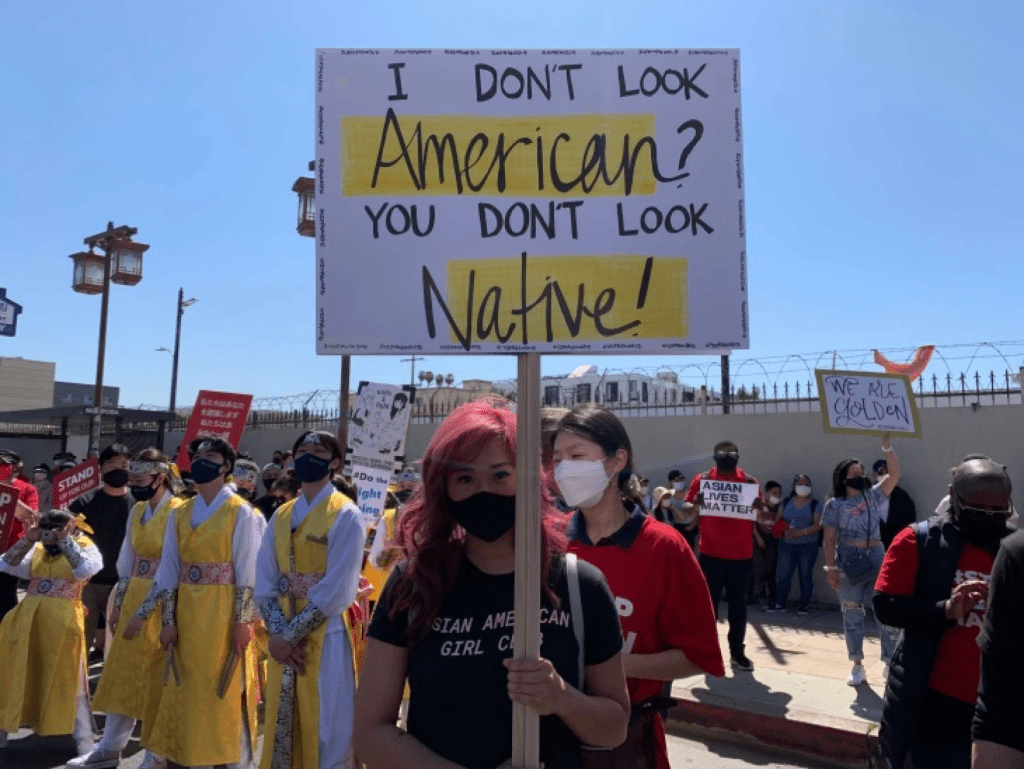
The question “Where are you from?” really means: “What race/ethnicity are you?”, with undertones of “You don’t belong here because you’re not ‘from’ here.”
But yes, I do happen to be the child of immigrants, from East and Southeast Asian countries. There is a history of Chinese diaspora on my father’s side, as both his parents’ families fled China in the wake of the civil war and Mao’s rise to power. My grandmother’s father was a Chinese scholar who stayed behind while the rest of his family fled, trying to prevent the burning of books and preserve the ancient knowledge—that he had studied for many years of his life—held within them. My grandfather (爺爺) was a Taiwanese admiral who performed deep-sea rescue missions and still knew how to navigate by the stars; but I never got to hear his stories as my Chinese skills were always too poor.
My mother immigrated to the States in her early twenties with one of her sisters and my maternal grandfather (Lolo). Lolo was a clerk for the US Embassy in Manila; the lines of colonization run deep in the Philippines. What were we called before the Spanish came along? Indigenous traditions like tattooing are now considered taboo by most Filipino parents, who have been deeply indoctrinated in Catholicism for centuries. Tagalog, one of the many hundreds of languages spoken in the Philippines but the most widely known or recognized, in itself mirrors the colonized history of the country, as the Indigenous language is interspersed with Spanish and English terms. The way to say sorry in Tagalog? “Sorry po.” Someone asks you how you are and you want to say you’re kinda meh? “Okay lang.”
My primary language is and always has been English, despite the decade of Chinese school on Saturdays that I was absolutely terrible at. The language that my parents share is English, so that was what was always spoken at home. It was an odd way to grow up, not really feeling “American” and being othered at school while also realizing your parents also felt othered in their own ways—my dad will never consider anything but the Taiwan of his childhood as his home, while my mom strongly feels connected to Pasadena because she made it her home, yet she isn’t always treated as if she belongs here as much as others might be.
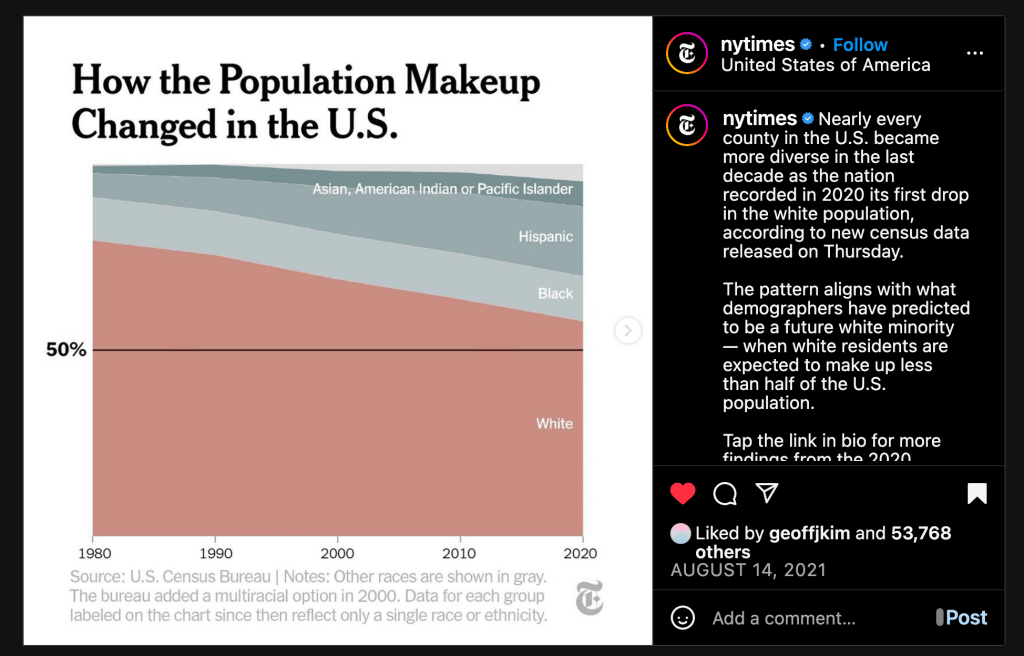
While I didn’t have the ‘typical’ American upbringing, the stereotype of what American means is shifting as the US becomes increasingly brown.
Representation of all types of childhoods across this large country is increasing, reaffirming the concept that the US is a country of immigrants, a place anyone can be from.
So yeah, I’m from here.
If you’re interested in some further thoughts, I wrote about my mixed cultural identity in this guest piece for Overachiever Magazine in October 2020.







 Nerdery & Nostalgia