
Left to languish in drafts; originally started in June of 2022, finished July of 2023…almost managed to get it up by June…
For many people of the global majority, existing in certain—especially Western/Global North—spaces constitutes resistance. Resistance against the status quo, of making space for yourself at the table, of refusing to be ignored or pushed aside.
Kehinde Wiley’s “A Portrait of a Young Gentleman,” on display at the Huntington Library and Gardens, is one such act of resistance. I can’t speak to the intentionality or the self-awareness of the curators, though I sincerely hope that this was their intention. However, I personally find that “A Portrait of a Young Gentleman” completely transforms the experience of visiting that particular wing of the European Art Gallery.
Recently, “Blue Boy”—the Thomas Gainsborough’s portrait is one of the museum’s most iconic pieces—was loaned to the National Gallery in London, while Joseph Wright’s “An Experiment on a Bird in an Air Pump” was loaned to the Huntington. During “Blue Boy”‘s absence, Wiley’s “Young Gentleman” was displayed in his usual place, a stunning contrast jumping off the wall as soon as you walked into the wing.
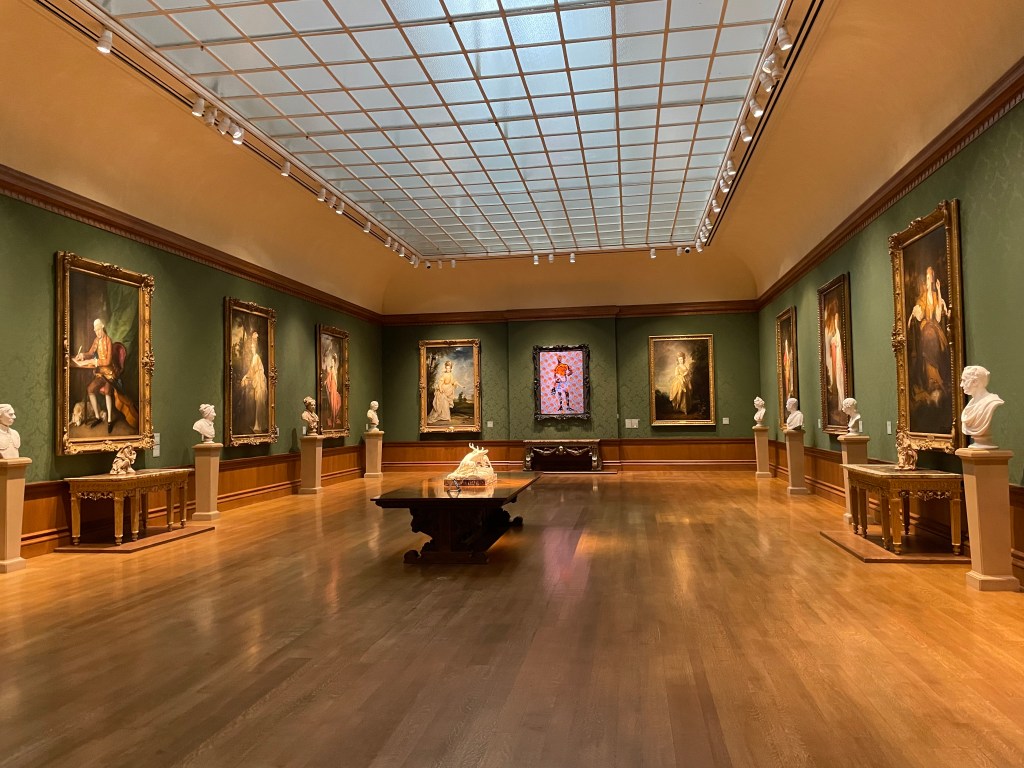
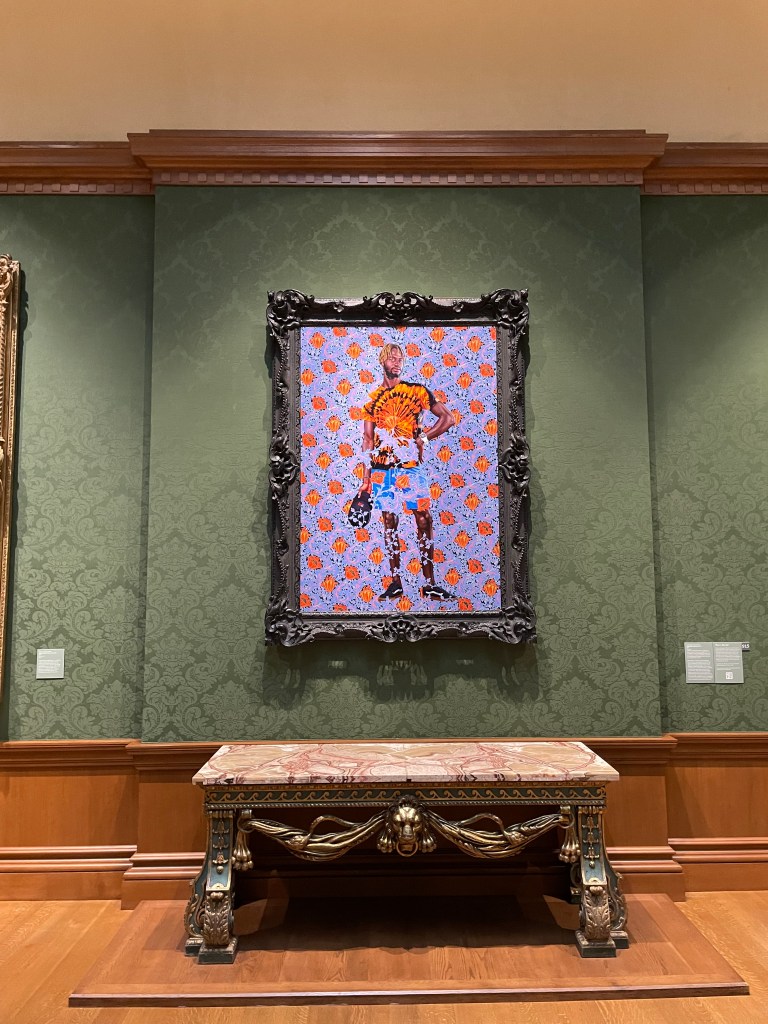
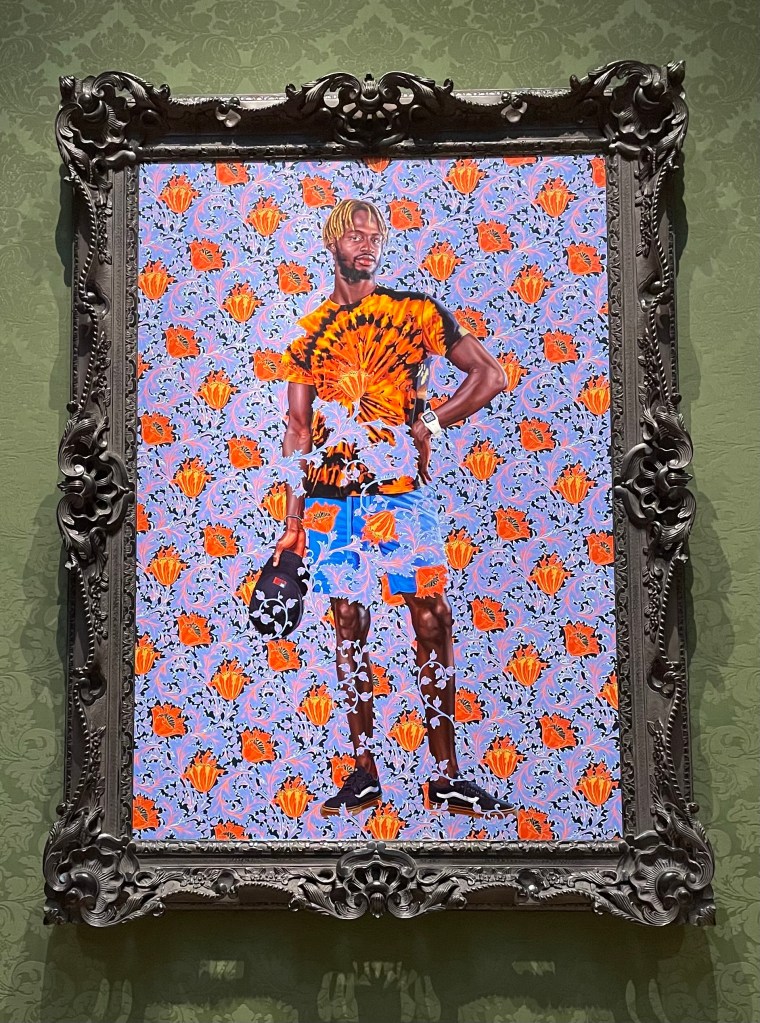
As soon as you set eyes upon the gallery, the vivid lavender and the fiery orange of the California poppies in the background of the portrait stand out against the muted, warmer tones of the other portraits and even the gallery itself. The stark impact of the matte black frame is appreciable under the lights. The detailed rendering of the Young Gentleman makes his figure pop and contrast, three dimensional against the sea of two dimensionality. His pose mimics that of Gainsborough’s Blue Boy, his expression serene and calm—but his very existence, a loud and proud presence in a sea of portraits of…to put it bluntly, colonizers, is a stunning and impactful statement. He commands attention and importance in a room dominated by whiteness and elitism, in a place of pride. His mere existence pushes back against the status quo that the gallery embodies.
With Blue Boy’s return, the young Gentleman remains in the gallery but has been placed opposite, continuing to resist the status quo with his continued presence. (I hope this remains the case as of this publishing!)

 Nerdery & Nostalgia