
A mild rant.
“Pasadena, California” never really seems to cut it for this one. But when they step it back from “Where are you from?” to “Where are your parents from?”, that’s where they get me.
And honestly, it’s only a fluke that my parents are actually immigrants. Filipinos were some of the first Asians in the United States. Filipinos were even put in human zoos in the early 1900’s. The Chinese were here since the early 1800’s, building the railroads. Asians have been the US for a while, so it’s absolutely plausible that my family—read: any Asian family—could have lived here for generations.
The question “Where are you from?” really means: “What race/ethnicity are you?”, with undertones of “You don’t belong here because you’re not ‘from’ here.”
But yes, I do happen to be the child of immigrants, from East and Southeast Asian countries. There is a history of Chinese diaspora on my father’s side, as both his parents’ families fled China in the wake of the civil war and Mao’s rise to power. My grandmother’s father was a Chinese scholar who stayed behind while the rest of his family fled, trying to prevent the burning of books and preserve the ancient knowledge—that he had studied for many years of his life—held within them. My grandfather (爺爺) was a Taiwanese admiral who performed deep-sea rescue missions and still knew how to navigate by the stars; but I never got to hear his stories as my Chinese skills were always too poor.
My mother immigrated to the States in her early twenties with one of her sisters and my maternal grandfather (Lolo). Lolo was a clerk for the US Embassy in Manila; the lines of colonization run deep in the Philippines. What were we called before the Spanish came along? Indigenous traditions like tattooing are now considered taboo by most Filipino parents, who have been deeply indoctrinated in Catholicism for centuries. Tagalog, one of the many hundreds of languages spoken in the Philippines but the most widely known or recognized, in itself mirrors the colonized history of the country, as the Indigenous language is interspersed with Spanish and English terms. The way to say sorry in Tagalog? “Sorry po.” Someone asks you how you are and you want to say you’re kinda meh? “Okay lang.”
My primary language is and always has been English, despite the decade of Chinese school on Saturdays that I was absolutely terrible at. The language that my parents share is English, so that was what was always spoken at home. It was an odd way to grow up, not really feeling “American” and being othered at school while also realizing your parents also felt othered in their own ways—my dad will never consider anything but the Taiwan of his childhood as his home, while my mom strongly feels connected to Pasadena because she made it her home, yet she isn’t always treated as if she belongs here as much as others might be.
While I didn’t have the ‘typical’ American upbringing, the stereotype of what American means is shifting as the US becomes increasingly brown.
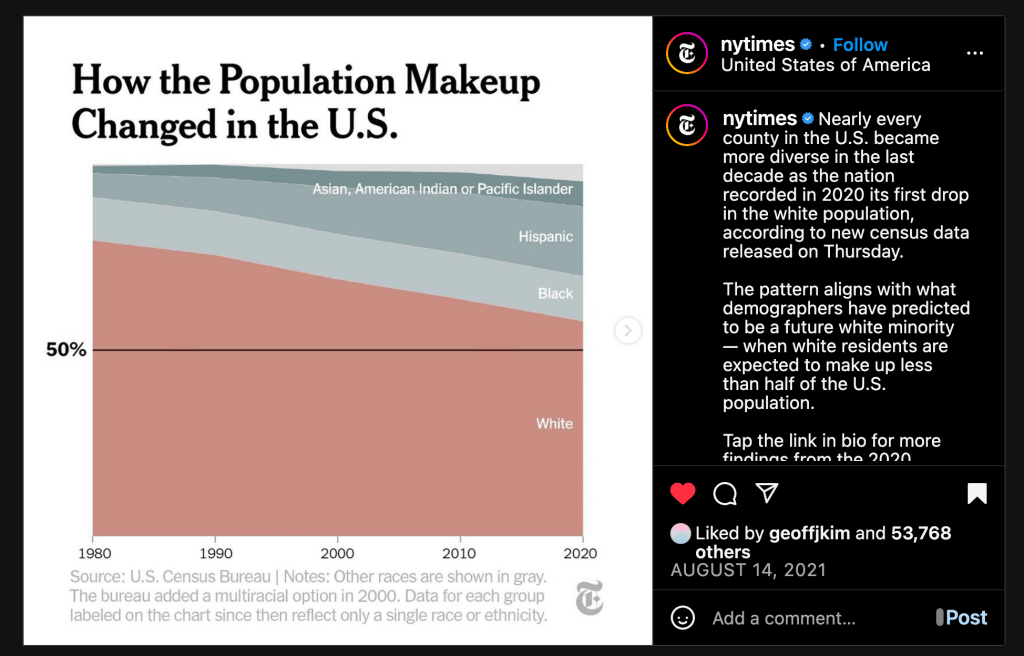
Representation of all types of childhoods across this large country is increasing, reaffirming the concept that the US is a country of immigrants, a place anyone can be from.
So yeah, I’m from here.
If you’re interested in some further thoughts, I wrote about my mixed cultural identity in this guest piece for Overachiever Magazine in October 2020.

 Nerdery & Nostalgia